

The Childhood Game of Bottle Bottoms
Long before smartphones and streaming, kids found joy in the small things. One of those joys was collecting Coca-Cola bottles and comparing the cities embossed on their bottoms. Each bottle carried the name of its bottling plant – a mark of pride and geography stamped in glass. The game was simple: trade and compare until you could brag that you had the bottle from the farthest-away place. It was a contest of distance, discovery, and luck, a way for kids to feel connected to other towns and states through something as ordinary as a soda bottle.

The rules weren’t written anywhere, but everyone understood them: if you found a Coke bottle that read “New Orleans, LA” while you lived in New York, you were holding a treasure. The farther the city, the greater your status in the game. It was geography class mixed with playground competition, and the bottles themselves were the trophies.

Fast-Forward: My Own Version of the Contest
Today, I find myself playing a grown-up version of that very same game. Instead of collecting full bottles from different towns, I’m rummaging through old dumps, beaches, and forgotten corners of New York, unearthing fragments of glass – many bottle bottoms – that tell their own stories. Some are “halfsies,” as I like to call them: pieces already tumbled halfway by the sea, softened but not finished. I put them through my own machine tumbler to complete the work nature started, giving them that smooth, frosted look that makes them feel timeless.
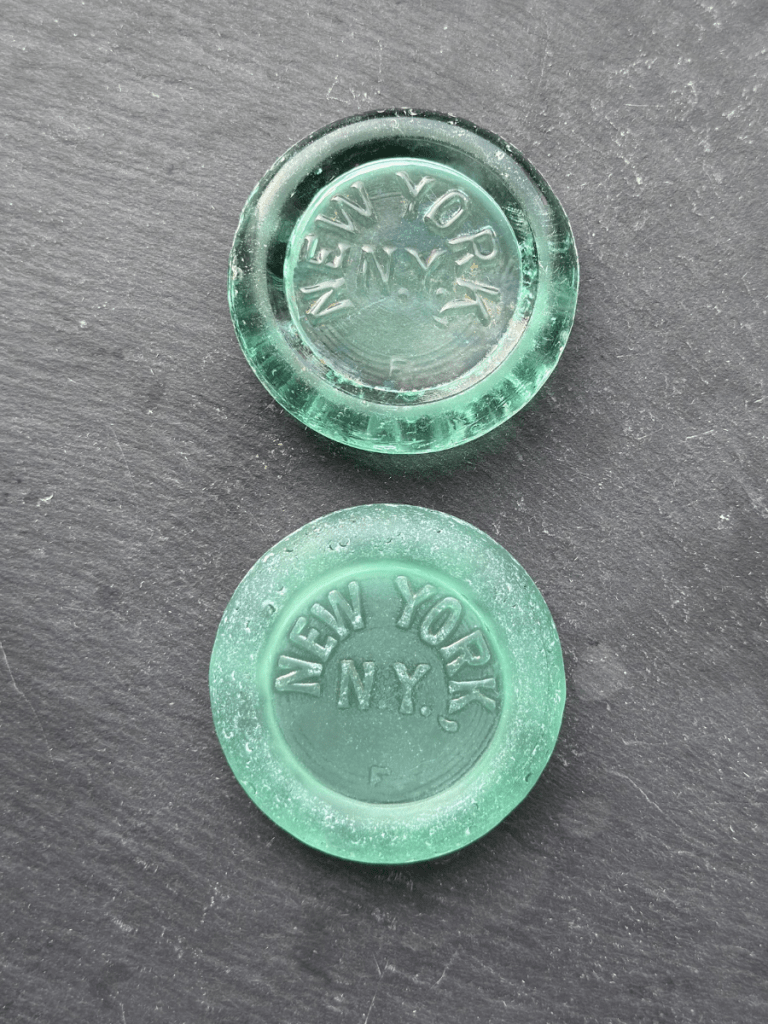
And just like those kids trading bottles, I can’t help but feel I’m still competing in a way. My challenge isn’t about outdoing my neighbors; it’s about seeing how far back in time I can reach – and how far across the map. It feels like I’m picking up where some 1940s or 1950s kid left off, trying to resurface their farthest-away find and wondering if theirs held the neighborhood record. How old a piece can I uncover? What stories does it carry? How far has it traveled, not just across geography, but through history?
The New York Connection
Some of my favorite finds are embossed with “NEW YORK N.Y.” on the base. There’s something grounding about holding a shard of glass that once belonged to this city I call home. I know the years of a couple of these pieces for certain: one from 1949, another from 1953. I saw the full bottles before they broke down into fragments, with those dates stamped clearly in the embossed glass.
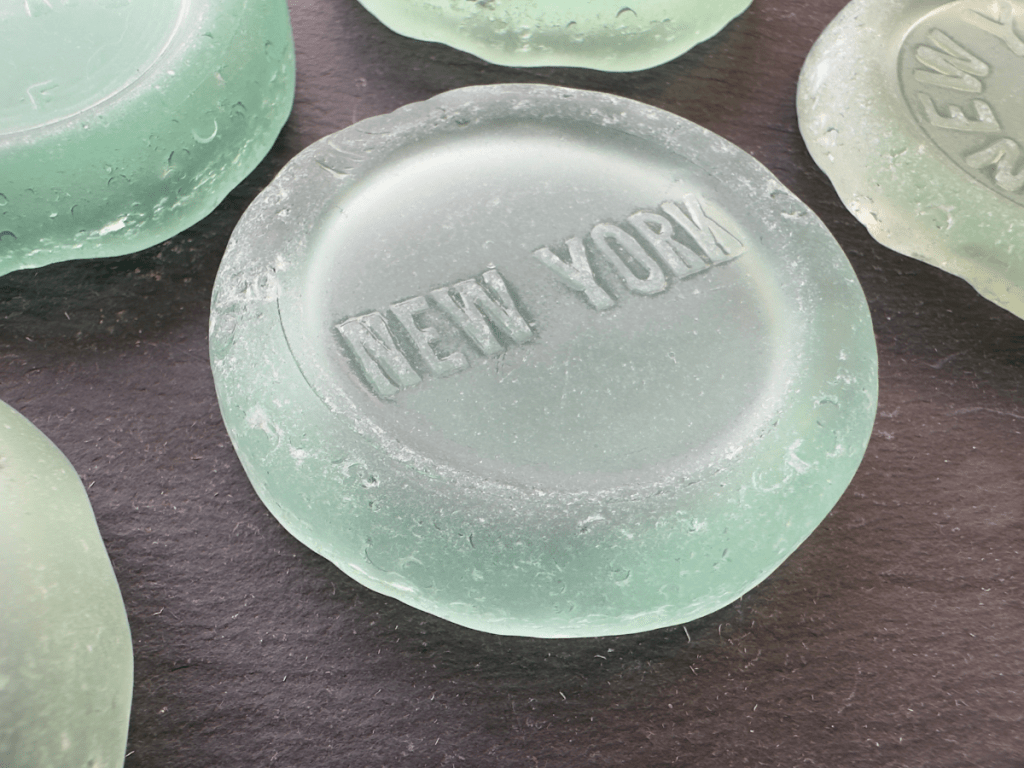
But then there’s the mystery piece. Same aqua-green color, same New York embossing, but no date. I study it, compare it, and wonder: is it early 40’s? It’s the thrill of the game. The unanswered question keeps me digging, keeps me searching for the complete version of the bottle this belonged to.
Fonts You Can Hold
Having held a career in brand marketing, I’ve always been fascinated by fonts, by the way lettering carries identity. And Coca-Cola, more than almost any other brand, understood the power of typography. Their script is iconic, instantly recognizable around the world. But even beyond the script, the embossed fonts on these bottle bottoms feel like a secret archive of design. Each curve, each serif, each spacing decision is a little fingerprint of the era in which it was made.
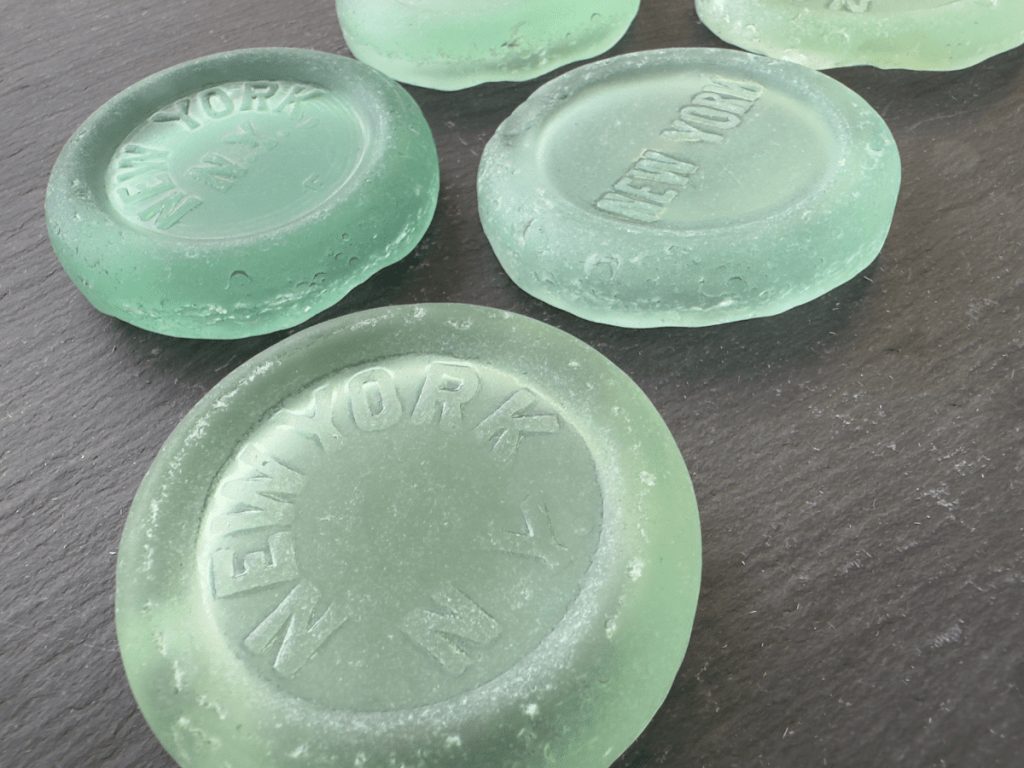
When I hold one of these Coke bottoms, I’m not just holding glass. I’m holding typography, branding, and history in my palm. It’s branding you can literally feel with your fingertips.
The Color of Coca-Cola Glass
People often call it Coca-Cola green, but the truth is more complex. Depending on the batch, the sand, and the manufacturing era, Coke bottles range from strong green to soft aqua, sometimes even appearing more blue than green. Lining them up side by side, the differences are striking – each one its own variation of a color we think of as uniform. To me, this spectrum of glass shades is part of the fascination. They’re like fingerprints, no two exactly alike.

The Craft Angle
Of course, these pieces don’t just sit in a drawer collecting dust. Once they’re fully tumbled, they become material for new creations. Their flat, round shape makes them perfect for projects like sea glass drawer pulls, mosaic tiles, or resin inclusions. Each one is unique — no two embossings are identical, no two shades of aqua are quite the same. Crafters love them for exactly that reason. They’re fragments of history reborn as functional art. And if you’d like to work with some yourself, I make these vintage Coke bottoms available through my shop – currently by custom order, with easy click-to-buy listings coming soon.
Their flat, round shape makes them perfect for projects like drawer pulls and mosaics. I often imagine someone opening a drawer fitted with a knob made from a 1953 Coke bottom. It’s a tiny daily ritual, infused with mid-century branding and coastal history. That’s the beauty of these pieces: they bridge nostalgia and creativity, memory and modern use.
Why This Matters to Me
So why write about old Coca-Cola bottle bottoms? Because they represent everything I love about glass. They’re imperfect yet beautiful. They’re ordinary objects transformed into relics. They’re functional design turned into collectible fragments. And they carry stories – stories of a brand, of a city, of a time when kids traded bottles like treasures.
And here I am, all these years later, carrying on my own version of that contest. Not to beat anyone, not to collect the farthest-away city, but to see how far I can go into the past, how much I can learn from what’s left behind. Each find is a victory, not just for me, but for the story of glass itself. And sometimes I wonder if the person who once finished a Coke and tossed that bottle away could ever have imagined that, decades later, its bottom would be smoothed by the sea, turned in a tumbler, and end up here in my hands – cherished as both history and art.
The Game Goes On
When I tumble a Coke bottom and hold it up to the light, I see more than just frosted glass. I see kids in the 1940s comparing city names on playgrounds. I see soda fountains buzzing with chatter in 1953. I see New York streets filled with bottles that would one day be discarded, buried, and rediscovered. And I see the joy of turning history into something new – a craft piece, a drawer pull, a conversation starter.
The game goes on. Only now, the scoreboard isn’t about who can find the bottle from the farthest town. It’s about how much beauty and story we can uncover in the fragments right beneath our feet.
Where to Find Them
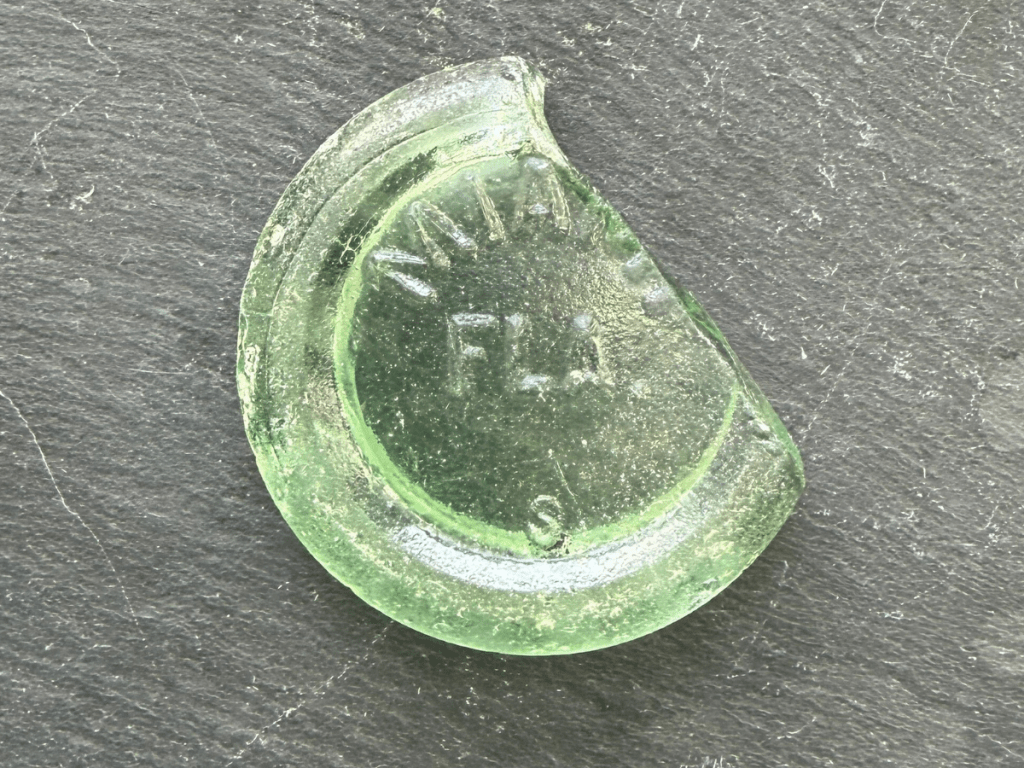
If you’ve fallen in love with these Coke bottle bottoms the way I have, you can actually own some yourself. They are now available in my shop! Each piece is unique, carrying its own story, and ready to be transformed into your next project or simply admired as history in glass.
 blog.brooklynseaglass.com